The Onion Theory: The Ultimate Guide to Outdoor Layering for Running, Skiing, Cycling & Hiking (All Seasons)
ENGLISH VERSION 🇬🇧
Hey there, partner! 👋
You know that feeling when you’re grinding up a steep hill, sweat pouring down your face, but the moment you stop for a summit selfie, your teeth start chattering uncontrollably? Or that moment in January when you head out for a run bundled up like a marshmallow, only to be boiling in your own juices after one kilometer?
If you’re nodding along, you’re in the right place. I’m Michal Kudrna, and this isn’t just another boring article copied from a generic catalog. This is your new, complete manual for survival and comfort. The outdoors isn’t about suffering; it’s about enjoying every moment, whether it’s a blizzard or a heatwave.
Today, we are going to deconstruct layering down to the molecular level. We’ll go sport by sport, season by season. And because I know not everyone wants to spend their whole paycheck on one jacket, for each activity, I’ll show you a „Smart Low-Cost“ option (beginner) and a „High-End Performance“ option (for those who want the best).
Grab a coffee (or crack open an electrolyte drink), this is going to be juicy!
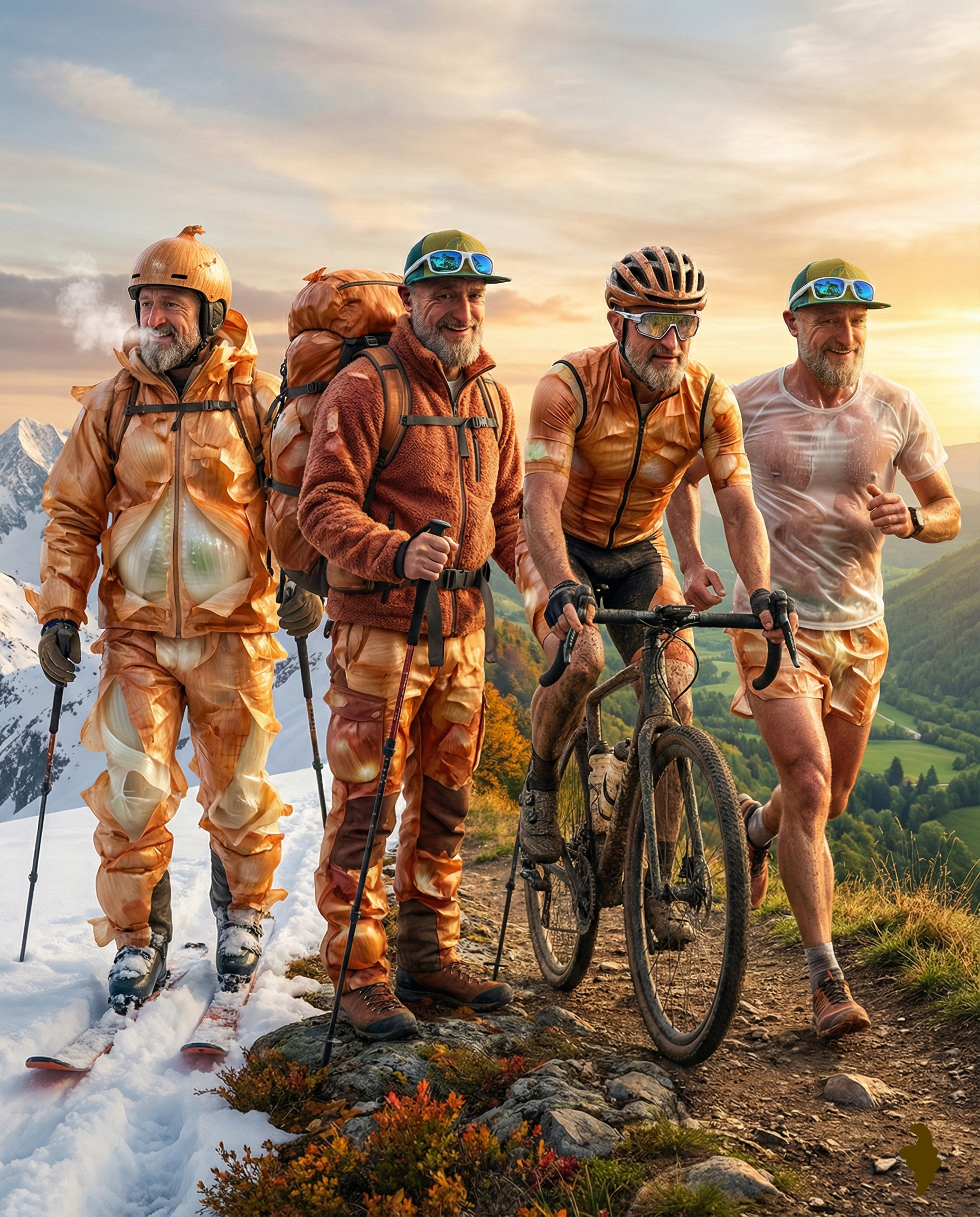
🧅 CHAPTER 1: Anatomy of the Onion (Theory You Must Know)
Before we start shopping, we need to understand the physics. Why is it better to wear three thin layers than one thick one? Because air insulates. Layering allows you to regulate your temperature like a thermostat.
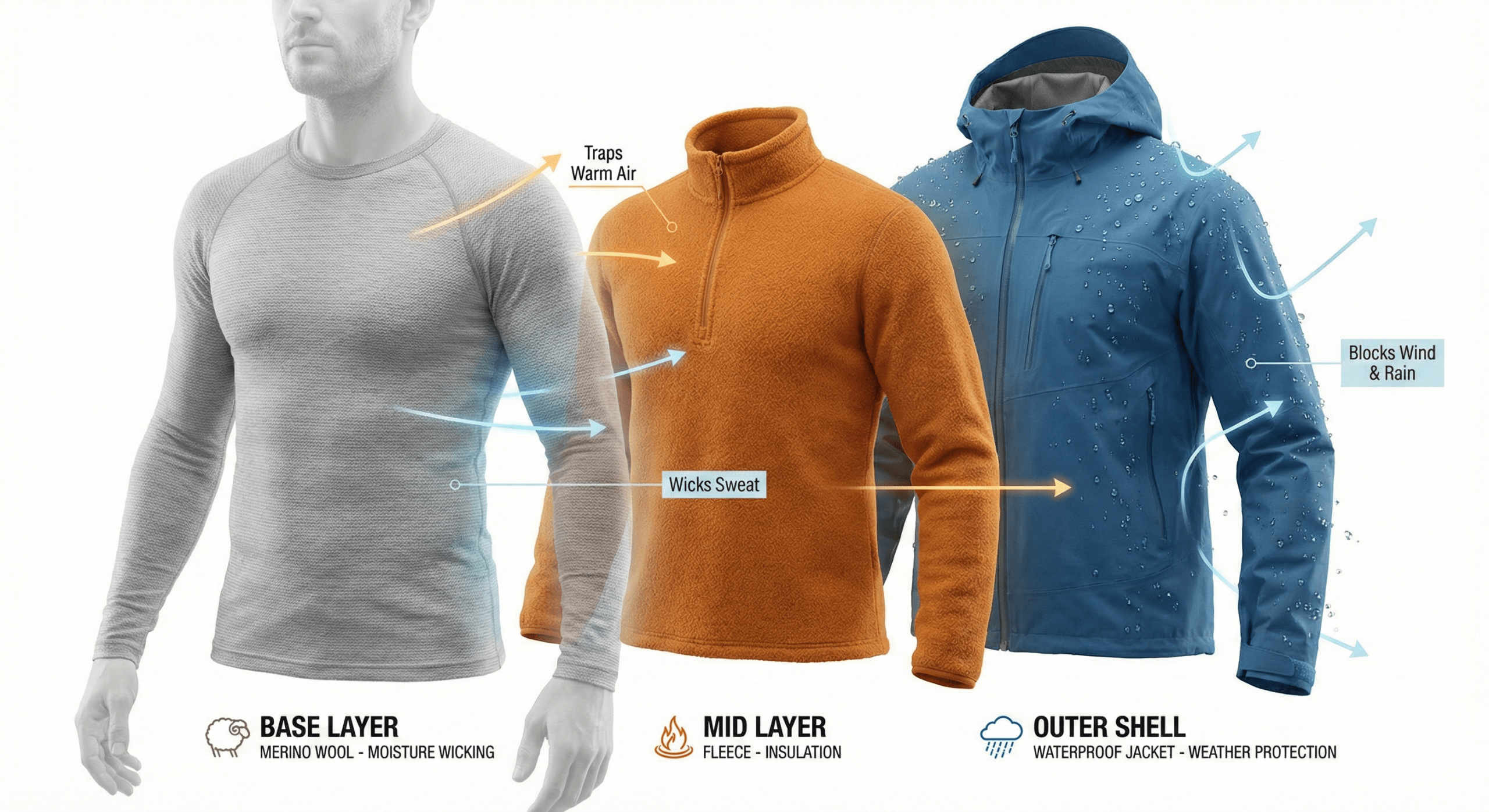
1. Base Layer – Your Second Skin
Its job is NOT primarily to warm you, but to move moisture (sweat) away from your body.
-
Synthetics (Polyester, Polypropylene): Fibers are smooth and non-absorbent. Sweat „slides“ off them into the next layer.
-
Best for: High intensity (running, cycling, racing).
-
Con: Smells bad faster (bacteria love smooth fibers).
-
-
Merino Wool: A natural miracle. The fiber has scales that trap air. It keeps you warm even when wet.
-
Best for: Hiking, ski touring, multi-day trips.
-
Pro: Doesn’t stink even after three days.
-
-
COTTON IS FORBIDDEN! Cotton absorbs sweat, feels cold, and takes hours to dry. Keep it for sleeping in the cabin, not for the trail.
2. Mid Layer – The Heat Engine
This is where warmth is „generated“ and trapped. This layer must be breathable to let steam pass through.
-
Fleece / Technical Fleece: A classic. Nowadays, „Grid“ structures (waffle patterns) are in—they are lighter and breathe better.
-
Active Insulation (Primaloft, Polartec Alpha): Modern fibers that are warmer than fleece but lighter.
3. Outer Layer (Shell) – The Shield
-
Softshell: The magic compromise. Blocks 80-90% of wind, withstands light rain, but breathes excellently. You’ll spend most of your time in this.
-
Hardshell (Membrane): Gore-Tex, Dermizax, etc. Waterproof, windproof, but breathes less. This is your armor for the storm.
4. Static Insulation – Into the Backpack!
Down jacket or thick synthetic. You don’t wear this while moving (you’d cook), but you put it on OVER everything when you stop.
🏃 CHAPTER 2: RUNNING (Road & Trail)
Motto: „Be bold, start cold.“
Runners produce huge amounts of heat. The most common mistake is dressing for the thermometer, not for the „exertion temperature.“
❄️ WINTER (Temps -5°C to +5°C)
Crucial: Protect joints and chest; back needs to vent.
-
Beginner (Low-Cost):
-
Body: Synthetic long sleeve (Decathlon Kiprun). A light windbreaker on top (e.g., Kilpi) to block wind.
-
Legs: Thermal tights (brushed fleece inside).
-
Budget: approx. €100.
-
-
Advanced (High-End):
-
Body: Craft Active Extreme base layer (keeps you dry). Top it with Dynafit Alpine Wind or Gore Wear. These jackets have a membrane only on the front; the back is mesh.
-
Legs: La Sportiva winter trail tights with Windstopper panels on thighs/knees.
-
Budget: €300 – €500.
-
☀️ SUMMER (Above 20°C)
-
Layering: It’s all about cooling. Look for „cooling effect“ materials (Craft Nanoweight). Singlets with large mesh.
-
Prevention: Watch out for chafing. Long, tight „2in1“ shorts are a lifesaver.
🎒 CHAPTER 3: HIKING & TREKKING
Motto: „Flexibility above all.“
Hiking involves alternating effort (climbing) and rest (ridges, snacks). You must react fast.
⛰️ MOUNTAIN SUMMER & AUTUMN
Morning is 5°C, noon is 25°C, windy at the peak.
-
Base: Merino Wool. Short sleeve (150g/m2). I recommend Devold (Breeze series) or Icebreaker. Even if you sweat, it doesn’t feel cold.
-
Mid: Light fleece. Patagonia R1 or Direct Alpine technical hoodies.
-
Shell: Always have a lightweight waterproof jacket („Paclite“) in your pack. Hannah or Mammut make great packable ones.
-
Pants: Zip-off pants are „retro“ but practical. For a modern look, go for light softshell pants (Mammut Courmayeur).
❄️ WINTER HIKING / SNOWSHOEING
This is about safety.
-
High-End Setup:
-
Base: Merino Devold Expedition (dual layer, extremely warm).
-
Mid: Wool sweater or heavier fleece.
-
Shell: 3-layer jacket Direct Alpine Guide or Tilak. A tank that survives anything.
-
Static: Down jacket (Sir Joseph or Rab) in the pack for stops.
-
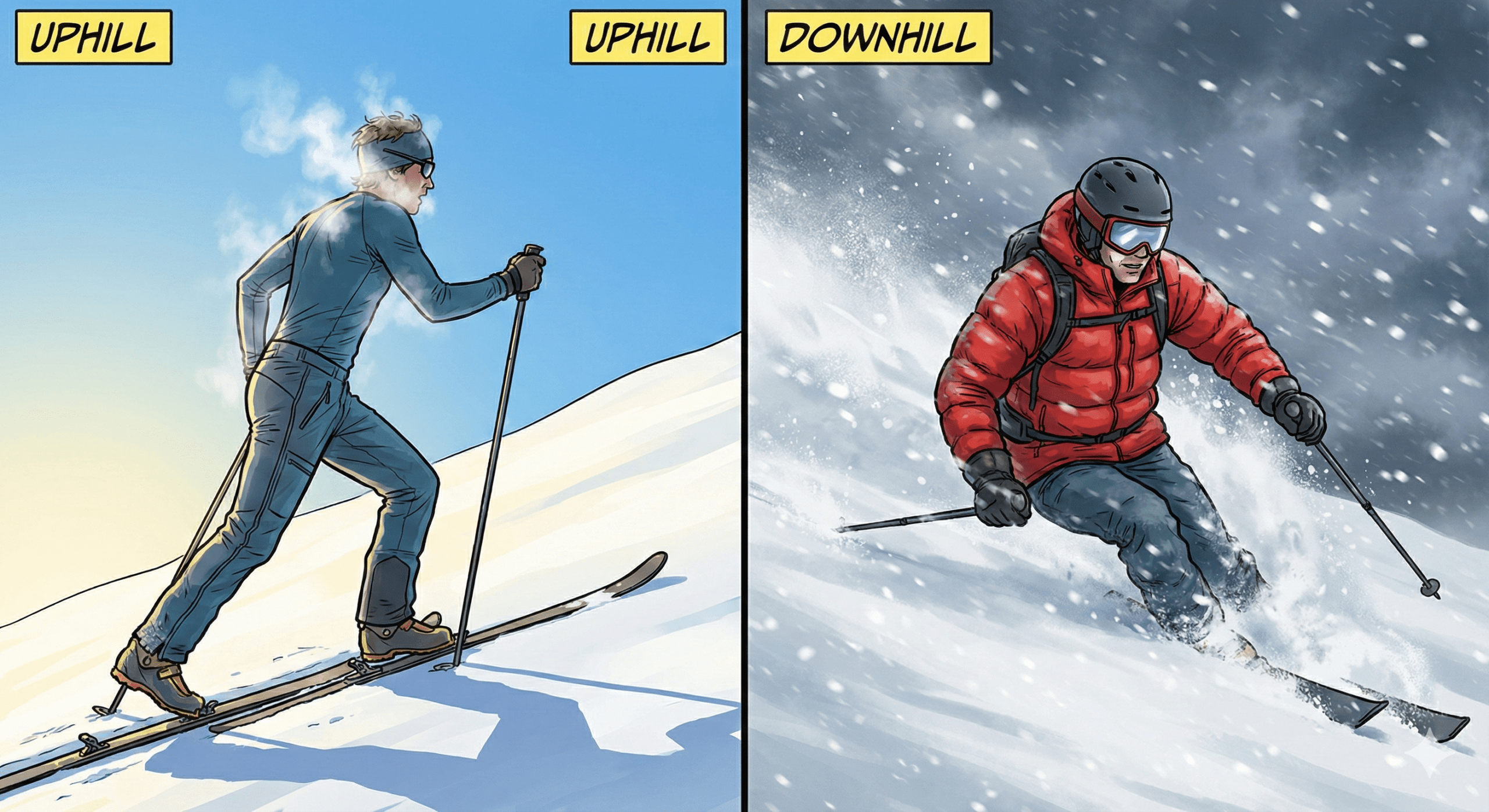
🎿 CHAPTER 4: SKI TOURING (Skialp)
Motto: „Strip down going up, layer up going down.“
Ski touring is the king of thermoregulation. Extreme energy output uphill vs. freezing wind downhill.
Dressing Protocol (Step by Step):
-
Parking Lot: You are cold. Good. You wear only a base layer and thin softshell pants.
-
Ascent (Skinning): Pace increases. If no wind, go in just the t-shirt. If windy, wear a Hybrid Jacket (Dynafit or Crazy Idea). Windproof chest, mesh back.
-
Ridge: Add a hood or thin windbreaker.
-
Summit (Transition): Fast! Skins off. Immediately (before skins are packed) throw on your Insulation Jacket(Primaloft or Down). Put a Hardshell over it if snowing.
-
Descent: Ski down in warmth.
🧤 Hand Tips:
-
Bring two pairs! Thin working gloves for the way up (they will get wet) and thick mittens (e.g., Ortovox with wool liner) for the way down.
📉 BRAND COMPARISON TABLE
Conclusion: Michal’s Three Golden Rules
-
A generic cotton underwear will kill the performance of a $500 jacket. Start with the base layer.
-
Care for your gear. You MUST wash membrane jackets (with special detergent like Nikwax), otherwise, salt from sweat clogs the pores. Then impregnate.
-
Listen to your body. Charts are nice, but everyone has a different thermostat. Keep a log: „It was -5°C, I wore a tee and fleece, and I was hot.“ Next time you’ll be smarter.
Now? Turn off your computer and go outside! The mountains are calling. 🏔️ Michal